Saludos a mis querido lectores. El deseo que tuve hoy de hacerme sentir la palabra religión, algo mas universal y unificante me llevo a este sitio de internet, el cual esta dedicado al dialogo monastico interreligioso.
En el encontre muchos escritos, el cual comparto hoy, copiado integro del sitio original se titula como sigue "A Comparative Consideration of Types of Meditation".
Aparece en el articulo:
"Report on the Monastic Meeting at Petersham: Dr. Daniel Goleman and Fr. M. Basil Pennington on A comparative consideration of types of meditation" escrito por Sr. Mary L. O'Hara, CSJ
inicia cita "from Bulletin 1, October 1977
A Comparative Consideration of Types of Meditation
The presentation was made by Father Basil Pennington—a monk of commanding presence and encyclopedic learning, of contemplative simplicity and boundless energy.
Christian teachers should teach more by their lives and should make room for the teacher. The best way to bring people to Eastern spirituality is for them to be into their own way and tradition in depth.
Interest in meditation can be seen from the articles appearing these days: “10 Journeys for the Spirit” (New Yorker); “Meditation Without Mystery” D. Goleman (Psychology Today)
It is important to clarify terms when dialoging with the East. Meditation usually means contemplation for Easterners, while contemplation may mean discursive meditation. Any meditative practice has to be part of a life context. This is where a method such as T.M. seems to fall short of practitioners’ long term needs. Can a meditative technique be transposed from one culture to another and be lived in depth? This is a consideration raised by the lives of Dom Dechanet and Abbot Tholens. Does following an Eastern method of prayer mean moving out of the traditional community? What about our vow of stability?
Types of Christian Meditation (4 of many types)
1. Benedictine/Cistercian—Lectio, Meditatio, Oratio, Contemplatio. Faith begins with hearing/reading the word and response to it moves one on to other levels.
2. St. John Cassian—author of the Institutes and Conferences. In the conferences on prayer, Abbot Isaac said the formula for prayer handed down from the fathers was chosen from the words of Scripture, “O God make speed to save me; O Lord make haste to help me.” This was to be used to stay in God’s presence at all times. It should be said at every moment of the day, it should be the last thing you say at night and the first thing you say in the morning.
3. The “Jesus” Prayer. In Eastern Christian tradition it developed from a simple form to a more sophisticated one. It is a prayer of the heart—Hesychasm—quietness. Nicephorus, the Solitary: Attention is repentance, renunciation of sin, turning to God, serenity of mind. It is necessary to seek a teacher who will show from his own sufferings what must be done. To breathe we use our lungs which develop the heart. Breathing in the words of the prayer we bring the prayer to our hearts. Together with the air we force the mind to enter into the heart and stay there and repeat the Jesus prayer. When our lips are silent, desires speak from the breast. We must force the heart to say only the Jesus prayer. St. Gregory of Sinai is considered the greatest teacher of Hesychasm. How shall a man discover or better be discovered by Christ whom he received at baptism? Through the fulfillment of the commandments, or by obedience to the spiritual father in the practice of the memory of God: “Lord Jesus Christ, Son of God, Have mercy on me”. St. Gregory describes the practice: Sit on a low stool 8 inches high, bow low, force the mind into the heart and repeat “Lord Jesus Christ;” after some time switch to the second part of the prayer. Control the breath, breathing slowly and quietly. This practice should always be taught personally and paced for the individual.
4. Cloud of Unknowing—by an unknown 14th Century English author. Sit relaxed and quiet. Prayer is a spontaneous desire springing to God. Center attention on God. It should take only a brief moment to do so. Use a short, meaningful word to do this. Do not strain the mind or the imagination. The word should be repeated internally with no thought or sound. This word should represent the fullness of God.
Discussion Period
We are looking for a way of life, not a method. Jesus never gave a method. He said: I am the way. The truth. His practice, however, gives some clues or ideas as to methods. But it was related to His culture and conditions and so must ours be. His basic experiences, however, were universally valid. He is above all teaching us to enter His inner life of relationship to His father. Can Eastern thought give insight into Christianity? Eastern thought is perhaps necessary to bring mankind to maturity. Jesus freed men from the rigidities of the Rabbinical School. Identification is a stage from which one goes beyond to find one’s own identity. The temptation of all religions is to stay at the level of identification. Methods are helpful, but only as a means. Ritual has a place but form and meaning must be truly one. The gospel message is simple. Everything, including methods, which help purity of heart, can be used, but not idolized.
Part of the monastic “return” of Sr. Donald’s talk could be opening to other religions and cultures. Is it our Western scientific mind which leads us to call these things “methods”? Not necessarily. This was the attitude of the Eastern monks at Bangalore. These techniques have arisen from the structures of the psyche. Jean Houston’s studies offer various levels of psychedelic experiences:
1. Sensory—Franciscan
2. Recollective—Jesuit
3. Symbolic—Benedictine
4. Silent—Cistercian—Carmelite—Zen
Christianity is unthinkable without the fourth level-- silence gathering up all the creation. Christ came into a Jewish context, but there is no reason why that same experience of union with the Father can not be lived in another religion. Jesus was not a Christian. Perhaps Christianity must die as a seed.
The afternoon session was devoted to an explanation of the “centering prayer” so called from Merton ‘s conviction that we go to God through our deepest center. It grows out of the tradition of the Cloud of Unknowing. People come to the monastery asking for help in prayer. This is an answer.
Sit relaxed and comfortable in a chair with the back well supported. When Jesus said, “I will refresh you” he meant body as well as soul. Eyes gently closed. Three basic rules to the technique:
1. Move in faith to the reality that God is present within. When we go to our deepest self, we find not only God’s image, but our deepest self coming from God’s creative love. Come out of this prayer slowly through a moment of affective prayer.
2. Take up one simple prayer word which naturally effects a meaningful response in you -- e.g., Lord, God, Love, Life—and let it repeat itself within. The aim is not an ejaculatory prayer, but to abide in the Presence. The word is there only to help this.
3. Whenever we become aware of anything else, we simply let it go and return to our prayer word.
It is strongly urged that one take at least two short periods (20 minutes) for this prayer each day. The best time of day for this prayer seems to be early in the day and before eating in the evening. The centering prayer was seen as well founded, starting with the discursive and then naturally moving into contemplation, whereas many Eastern techniques perhaps start too high.
TM and Centering Prayer
TM uses a meaningless sound whereas centering prayer uses the most meaningful word. In TM there are very detailed instructions given, and initial progress is checked after three and ten days. Also, the mantra is picked very carefully as it gets more powerful at finer levels. TM is geared to intensify and purify the nervous system so that a dynamic samadhi may be maintained at all times. TM could be compared to Jnana Yoga in its approach, while the centering prayer could be compared to Bhakti Yoga in its more devotional aspect. An aspect of both approaches is the transcendence of the word used. We can use any faculty with which to transcend—a sort of divine psychotherapy allowing the opportunity to empty the unconscious of its needless “junk.” If the unconscious is unloaded too fast, one may become aware of things that he is not prepared to face. Since these two techniques enter essentially non-directed atmosphere, they are performed for relatively short periods of time. When these methods are motivated by personal ambition toward attainment, we often find a loss of prudence in their use and a jump into extremism that only turns back on oneself. These methods are fully effective only when guided by prudent men. The silence that is stressed is not important as an end in itself, but as a space in which one is freed from endless desires and preoccupations, entering a pure and natural space in which one may come to his true self. Each comes to this self-realization in his own time and rate. In this spirit St. Teresa has reminded us that our natural movement is into God, realizing that conditions and methodology are a means and not an end. (See Father Basil’s book: Daily We Touch Him)
In the evening the group addressed itself to considering the primary focus of the meeting: exploring ways to aid monasteries in opening to the heritage of the East. See the summation of the conclusions committee at the end of this report."
fin de la cita.
Todos los Grandes Misticos Cristianos en alguna forma han recomendado la meditación como ayuda en la vida diaria de oración, o han practicado alguno de ésos métodos. Espero les haya gustado, igual que a mi.
Showing posts with label Meditacion y sus beneficios. Show all posts
Showing posts with label Meditacion y sus beneficios. Show all posts
Thursday, April 16, 2009


Sunday, May 11, 2008
EL MÉTODO DE ORACIÓN HESICASTA

EL MÉTODO DE ORACIÓN HESICASTA
Según la enseñanza del padre Serafín del Monte Athos
Cuando X, un joven filósofo, llegó al Monte Athos, había leído ya un cierto número de libros sobre la espiritualidad ortodoxa, particularmente la pequeña filocalia de la oración del corazón en los relatos del peregrino ruso. Estaba seducido sin estar verdaderamente convencido. Una liturgia vivida en su ciudad le había inspirado el deseo de pasar algunos días en el Monte Athos, con ocasión de sus vacaciones en Grecia, para saber un poco más sobre el método de la oración de los hesicastas, esos silenciosos a la búsqueda de "hesychia", es decir, de paz interior.
Contar con detalle cómo llegó al padre Serafín, que vivía en un eremitorio próximo a San Pantaleón, sería demasiado largo. Digamos únicamente que el joven filósofo estaba un poco cansado. No encontraba a los monjes a la altura de sus libros. Digamos también que, si bien había leído varios libros sobre la meditación y la oración, no había rezado verdaderamente ni practicado una forma particular de meditación y lo que pedía en el fondo no era un discurso más sobre la oración o la meditación sino una "iniciación" que le permitiera vivirlas y conocerlas desde dentro por experiencia y no sólo de "oídas".
El padre Serafín tenía una reputación ambigua entre los monjes de su entorno. Algunos le acusaban de levitar, otros de que gritaba y gemía, algunos le consideraban como un campesino ignorante, otros como un venerable staretz inspirado por el Espíritu Santo y capaz de dar profundos consejos así como de leer en los corazones.
Cuando se llegaba a la puerta de su eremitorio, el padre Serafín tenía la costumbre de observar al recién llegado de la manera más impertinente: de la cabeza a los pies, durante cinco largos minutos, sin dirigirle ni una palabra. Aquéllos a quienes ese examen no hacía huir, podían escuchar el áspero diagnóstico del monje:
En usted no ha descendido más abajo del mentón.
De usted, no hablemos. Ni siquiera ha entrado.
Usted... no es posible... que maravilla. Ha bajado hasta sus rodillas...
Hablaba del Espíritu Santo y de su descenso más o menos profundo en el hombre. Algunas veces a la cabeza, pero no siempre al corazón ni a las entrañas... Así es como juzgaba la santidad de alguien, según su grado de encarnación del espíritu. El hombre perfecto, el hombre transfigurado era para él, el habitado todo entero por la presencia del Espíritu Santo de la cabeza a los pies. "Esto no lo he visto sino una vez en el staretz Silvano, decía, era verdaderamente un hombre de Dios, lleno de humildad y de majestad".
El joven filósofo no estaba aún ahí. El Espíritu Santo sólo había encontrado paso en él "hasta el mentón". Cuando pidió al padre Serafín que le hablase de la oración del corazón y de la oración pura según Evagiro Póntico, el padre Serafín comenzó a gemir. Esto no desanimó al joven, que insistió. Entonces el padre Serafín le dijo: "Antes de hablar de la oración del corazón, aprende primero a meditar como la montaña...". Y le mostró una enorme roca: "Pregúntale cómo hace para rezar. Después vuelve a verme".
Meditar como una montaña.
Así comenzó para el joven una verdadera iniciación al método de oración hesicasta. La primera meditación que le habían propuesto se refería a la estabilidad, al enraizamiento de un buen cimiento.
En efecto, el primer consejo que se puede dar al que quiere meditar no es de orden espiritual sino físico: siéntate. Sentarse como una montaña quiere decir tomar peso, estar grávido de presencia. Los primeros días al joven le costaba mucho quedarse inmóvil, con las piernas cruzadas, con la pelvis ligeramente más alta que las rodillas. Una mañana sintió realmente lo que quería decir meditar como una montaña. Estaba allí con todo su peso, inmóvil. Formaba una sola cosa con ella, silencioso bajo el sol. Su noción del tiempo había cambiado ligeramente. Las montañas tienen un tiempo distinto, otro ritmo. Estar sentado como una montaña es tener la eternidad delante, es la actitud justa para el que quiere entrar en la meditación: saber que está la eternidad detrás, adentro y delante de sí.
Antes de construir una iglesia es necesario ser piedra y sobre esta piedra (esta solidez imperturbable de la roca) Dios podría construir su Iglesia y hacer del cuerpo del hombre su templo. Así comprendía el sentido de la palabra evangélica: "Tú eres piedra y sobre esta piedra edificaré mi Iglesia".
Se quedó así varias semanas. Lo más duro era pasar varias horas "sin hacer nada". Era menester volver a aprender a estar, simplemente estar, sin objeto ni motivo. Meditar como una montaña era la meditación misma del Ser, "del simple hecho de Ser", antes de cualquier pensamiento, cualquier placer o dolor.
El padre Serafín le visitaba cada día, compartía con él sus tomates y algunas aceitunas. A pesar de esta régimen tan frugal, el joven parecía haber ganado peso. Su paso era más tranquilo. La montaña parecía haberle entrado en la piel. Sabía acoger su tiempo, acoger las estaciones, estar silencioso y tranquilo, a veces como la tierra árida y dura, otras veces como el flanco de una colina que espera la cosecha.
Meditar como una montaña había modificado igualmente el ritmo de sus pensamientos. Había aprendido a "ver" sin juzgar, como si diese a todo lo que crece en la montaña "el derecho de existir".
Un día, unos peregrinos, impresionados por la calidad de su presencia, le tomaron por un monje y le pidieron la bendición. Al enterarse de esto, el padre Serafín comenzó a molerle a golpes... El joven empezó a gemir.
"Menos mal, creía que te habías hecho tan estúpido como los guijarros del camino... La meditación hesicasta tiene el enraizamiento, la estabilidad de las montañas, pero su objetivo no es hacer de ti un tocho muerto sino un hombre vivo".
Tomó al joven del brazo y le condujo hasta el fondo del jardín donde, entre las hierbas salvajes, se podían ver algunas flores.
"Ahora ya no se trata de meditar como una montaña estéril. Aprende a meditar como una amapola, aunque no olvides por eso la montaña".
Meditar como una amapola
Así fue como el joven aprendió a florecer.
La meditación es ante todo un cimiento y eso es lo que le había enseñado la montaña. Pero la meditación es también una "orientación" y es lo que ahora le enseñaba la amapola: volverse hacia el sol, volverse desde lo más profundo de sí mismo hacia la luz. Hacer de ello la aspiración de toda su sangre, de toda su savia.
Esta orientación hacia lo bello, hacia la luz, le hacía a veces enrojecer como una amapola. Aprendió también que para permanecer bien orientada, la flor debía tener el tallo erguido. Comenzó, pues, a enderezar su columna vertebral.
Esto le planteaba algunas dificultades porque había leído en ciertos textos de la filocalia que el monje debía estar ligeramente curvado, con la mirada vuelta al corazón y las entrañas.
Cuando pidió una explicación al padre Serafín, los ojos del staretz le miraron con malicia. "Eso era para los forzudos de otros tiempos. Estaban llenos de energía y había que recordarles la humildad de la condición humana. Doblarse un poco el tiempo de la meditación no les hacía ningún daño... pero tú más bien tienes necesidad de energía y por tanto, en el tiempo de la meditación, enderézate, estáte vigilante, ponte derecho vuelto hacia la luz, pero sin orgullo... por otro lado, si observas bien la amapola, te enseñará no sólo el enderezamiento del tallo sino además una cierta flexibilidad bajo las inspiraciones del viento y también una gran humildad".
En efecto la enseñanza de la amapola consistía también en su fugacidad, en su fragilidad. Había que aprender a florecer pero también a marchitarse. El joven comprendía mejor las palabras del profeta: "Toda carne es como la hierba y su delicadeza es la de la flor de los campos. La hierba se seca, la flor se marchita... Las naciones son como una gota de agua de rocío en el borde de un cubo... Los jueces de la tierra apenas plantados, apenas arraigados..., se secan y la tempestad se los lleva como paja" (Is 40).
La montaña le había enseñado el sentido de la eternidad, la amapola le enseñaba la fragilidad del tiempo: meditar es conocer lo Eterno en la fragilidad del instante, un instante recto, bien orientado. Es florecer el tiempo en que se nos ha dado florecer, amar en el tiempo en que se nos ha dado amar, gratuitamente, sin por qué; puesto que ¿por qué florecen las amapolas?
Aprendía así a meditar "sin objeto ni beneficio", por el placer de ser y de amar la luz. "El amor tiene en sí mismo su propia recompensa", decía San Bernardo. "La rosa florece porque florece, sin por qué", decía también Angelus Silesius. La montaña florece en la amapola, pensaba el joven, todo el universo medita en mí. Ojal pueda enrojecer de alegría todo el tiempo que dure mi vida". Este pensamiento era sin duda excesivo. El padre Serafín comenzó a sacudir a nuestro filósofo y de nuevo le cogió por el brazo.
Lo llevó por un camino abrupto hasta el borde del mar, a una pequeña cala desierta. "Deja ya de rumiar como una vaca el sentido de las amapolas. Adquiere también el corazón marino. Aprende a meditar como el océano".
Meditar como el océano
El joven se acercó al mar. Había adquirido un buen cimiento y una orientación recta; estaba en buena postura. ¿Qué le faltaba? ¿Qué podía enseñarle el chapoteo de las olas?. El viento se levantó. El flujo y reflujo del mar se hizo más profundo y eso despertó en él el recuerdo del océano. En efecto, el viejo monje le había aconsejado meditar "como el océano" y no como el mar. Cómo había adivinado que el joven había pasado largas horas al borde del Atlántico, sobre todo de noche, y que conocía ya el arte de poner de acuerdo su respiración con la gran respiración de las olas. Inspiro, expiro... y luego soy inspirado, soy expirado. Me dejo llevar por el soplo como alguien que se deja llevar por las olas. Hacía el muerto, llevado por el ritmo de las respiraciones del océano. Eso le había conducido a veces al borde de extraños desvanecimientos. Pero la gota de agua, que en otro tiempo "se desvanecía en el mar" guardaba hoy su forma, su consciencia. ¿Era efecto de su postura?, ¿de su enraizamiento en la tierra?. Ya no era el ritmo profundizado de su respiración quién le llevaba. La gota de agua conservaba su identidad y sin embargo sabía "ser una" con el océano. De este modo el joven aprendió que meditar es respirar profundamente, dejar ir el flujo y reflujo del aliento.
Aprendió igualmente que aunque hubiese olas en la superficie, el fondo del océano seguía estando tranquilo. Los pensamientos van y vienen, nos llenan de espuma, pero el fondo del ser permanece inmóvil. Meditar a partir de las olas que somos para perder pie y echar raíces en el fondo del océano. Todo esto se hacía cada día un poco más vivo en él y se acordaba de las palabras de un poeta que le habían impresionado en su adolescencia: "La existencia es un mar lleno de olas que no cesan. De este mar la gente normal sólo percibe las olas. Mira cómo de las profundidades del mar aparecen en la superficie innumerables olas mientras que el mar queda oculto en ellas".
Hoy el mar le parecía menos "oculto en la olas", la unidad de las cosas parecía más evidente sin que esto aboliera la multiplicidad. Tenía menos necesidad de oponer el fondo y la forma, lo visible y lo invisible. Todo constituía el océano único de su vida.
En el fondo de su alma, ¿no estaba el ruah, el pneuma, el gran soplo de Dios?
"El que escucha atentamente su respiración, le dijo entonces el monje Serafín, no está lejos de Dios. Escucha quién est ahí, al final de tu expiración, quién está en el origen de tu inspiración". En efecto, había momentos de silencio más profundos entre el flujo y reflujo de las olas, había allí algo que parecía llevar en sí el océano.
Meditar como un pájaro
Estar sobre un buen cimiento, estar orientado hacia la luz, respirar como un océano no es todavía la meditación hesicasta, le dijo el padre Serafín; ahora debes aprender a meditar como un pájaro. Y le llevó a una pequeña celda cercana a su eremitorio donde vivían dos tórtolas. El arrullo de los dos animalitos le pareció de momento encantador pero no tardó en ponerle nervioso. Parece que escogían el momento en que caía dormido para arrullarse con las palabras más tiernas. Preguntó al viejo monje que significaba todo aquello y si esa comedia iba a durar mucho. La montaña, la amapola, el océano, podían pasar (aunque uno pueda preguntarse qué hay de cristiano en todo ello), pero proponerle ahora este pájaro lánguido como maestro de meditación era demasiado.
El padre Serafín le explico que en el Antiguo Testamento la meditación se expresa con la raíz traducida en general al griego por m‚l‚t‚ -meletan- y en latín por meditari-meditatio. En su forma primitiva la raíz significa "murmurar a media voz". Igualmente se emplea para designar gritos de animales, por ejemplo el rugido del león (Is 31,4), el piar de la golondrina y el canto de la paloma (Is 38,14), pero también el gruñido del oso.
"En el monte Athos no hay osos. Por eso te he traído junto a una tórtola, pero la enseñanza es la misma. Hay que meditar con la garganta, no sólo para acoger el aliento, sino para murmurar el nombre de Dios día y noche... Cuando eres feliz, casi sin darte cuenta canturreas, murmuras a veces palabras sin significado y ese murmullo hace vibrar todo tu cuerpo con una alegría sencilla y serena. Meditar es murmurar como una tórtola, dejar subir ese canto que viene del corazón, como tú has aprendido a dejar que suba a ti el perfume de la flor... Meditar es respirar cantando. Sin quedarnos mucho en su significado, te propongo que repitas, murmures, canturrees lo que está en el corazón de todos los monjes del monte Athos: "Kyrie eleison, Kyrie eleison... "
Esto no le gustaba mucho al joven filósofo. En algunas bodas o entierros lo había oído traducido por: "Señor, ten piedad".
El monje se puso a sonreir: "Sí, es uno de los significados de esta invocación, pero hay otros muchos. Quiere decir también "Señor, envía tu Espíritu", que tu ternura esté sobre mi y sobre todos", "que tu nombre sea bendito", etc, pero no busques demasiado el sentido de la invocación. Ella se te revelar por sí misma. De momento sé sensible y estáte atento a la vibración que despierta en tu cuerpo y en tu corazón. Procura armonizarla apaciblemente con el ritmo de tu respiración. Cuando te atormenten tus pensamientos recurre suavemente a esta invocación, respira más profundamente, manténte erguido y conocerás el comienzo de la hesiquia, la paz que da Dios sin engaño a los que le aman".
Al cabo de algunos días el "Kyrie eleison" se le hizo más familiar. Le acompañaba como el zumbido acompaña a la abeja cuando hace la miel. No lo repetía siempre con los labios. El zumbido se hacía entonces más interior y su vibración más profunda.
El "Kyrie eleison" cuyo sentido había renunciado a "pensar" le conducía a veces al silencio desconocido y se encontraba en la actitud del apóstol Tomás cuando descubrió a Cristo resucitado: "Kyrie eleison", mi Señor es mi Dios.
La invocación le llevaba poco a poco a un clima de intenso respeto por todo lo que existe. Pero también de adoración por lo que está oculto en la raíz de toda existencia.
El padre Serafín le dijo entonces: "Ya no estás lejos de meditar como un hombre. Tengo que enseñarte la meditación de Abraham".
Meditar como Abraham
Hasta aquí la enseñanza del staretz era de orden natural y terapéutico. Según el testimonio de Filón de Alejandría, los antiguos monjes eran "terapeutas". Más que conducir a la iluminación, su papel consistía en curar la naturaleza; ponerla en las mejores condiciones para que pudiera recibir la gracia, que no contradecía la naturaleza sino que la restauraba y cumplía. Es lo que hacía el monje con el joven filósofo enseñándole un método de meditación que algunos podrían llamar "puramente natural". La montaña, la amapola, el océano, el pájaro, eran otros tantos elementos de la naturaleza que recuerdan al hombre que debe ir más lejos, recapitular, los diferentes niveles del ser o incluso los diferentes reinos que componen el macrocosmos: el reino mineral, el reino vegetal, el reino animal... A menudo el hombre ha perdido el contacto con el cosmos, con la roca, con los animales y esto ha provocado en él desazones, enfermedades, inseguridades, ansiedad. La persona humana se siente "de más", extranjera en el mundo. Meditar era comenzar a entrar en la meditación y la alabanza del universo porque, como dicen los Padres, "todas las cosas saben rezar entes que nosotros". El hombre es el lugar en que la oración del mundo toma consciencia de ella misma; está para nombrar lo que balbucean las criaturas. Con la meditación de Abraham entramos en una consciencia nueva y más alta que se llama fe, es decir, la adhesión de la inteligencia y del corazón en ese "tú" que se transparenta en el tuteo múltiple de todos los seres.
Esa es la experiencia de Abraham: detrás del titilar de las estrellas hay algo más que estrellas, una presencia difícil de nombrar, que nada puede nombrar y que sin embargo posee todos los nombres.
Es algo más que el universo y que sin embargo no puede ser aprehendido fuera del universo. La diferencia que hay entre el azul del cielo y el azul de una mirada, más allá de todos los azules. Abraham iba a la búsqueda de esa mirada.
Después de haber aprendido el cimiento, el enraizamiento, la orientación positiva hacia la luz, la respiración apacible de los océanos, el canto interior, el joven estaba invitado a despertar el corazón. "He aquí que de repente tú eres alguien". Lo propio del corazón es, en efecto, personalizarlo todo y en este caso, personalizar al Absoluto, la fuente de todo lo que es y respira, nombrarlo, llamarle "mi Dios, mi Creador" e ir en su Presencia. Para Abraham meditar es mantener bajo las apariencias más variadas el contacto con esta Presencia. Esta forma de meditación entra en los detalles concretos de la vida cotidiana. El episodio de la encina de Mambr nos muestra a Abraham "sentado a la entrada de la tienda, en lo más cálido del día"; allí acoger a tres extranjeros que van a revelarse como enviados de Dios. Meditar como Abraham, decía el padre Serafín, es "practicar la hospitalidad: el vaso de agua que das al que tiene sed, no te aleja del silencio son que te acerca a la fuente. Meditar como Abraham, ya lo entiendes, no sólo despierta en ti paz y luz sino también el amor por todos los hombres". El padre Serafín leyó al joven el famoso pasaje del libro del Génesis en que se trata de la intercesión de Abraham.
"Abraham estaba delante de Yahvé... se acercó y le dijo: ¿Vas a suprimir al justo con el pecador? ¿Acaso hay cincuenta justos en la ciudad y no perdonarás a la ciudad por los cincuenta justos que hay en su seno...?" Poco a poco Abraham fue reduciendo el número de los justos para que Gomorra no fuera destruida. "Que mi Señor no se irrite y hablaré una vez más: ¿Acaso se encontrarán Diez?" (Gen 18,16)
Meditar como Abraham es interceder por la vida de los hombres, no ignorar su corrupción pero sin embargo no desesperar jamás de la misericordia de Dios.
Este estilo de meditación libera el corazón de cualquier juicio y condena, en todo tiempo y lugar. Aunque sean muchos los horrores que pueda contemplar, llama al perdón y a la bendición.
Meditar como Abraham lleva aún más lejos. Las palabras pugnaban por salir de la garganta del padre Serafín, como si quisiera ahorrar al joven una experiencia por la que él mismo había debido pasar y que despertaba en su memoria un temblor casi sutil... esto puede llevar hasta el sacrificio... y le citó el pasaje del Génesis en que Abraham se muestra dispuesto a sacrificar a su propio hijo Isaac: "Todo es de Dios, murmuró el padre Serafín, Todo es de El, por El y para El. Meditar como Abraham te lleva a una total desposesión de ti mismo y de lo que te es más querido... Busca lo que valoras más, lo que identifica tu yo... para Abraham era su hijo único. Si eres capaz de esta donación, de ese abandono moral, de esa confianza infinita en lo que trasciende toda razón y todo sentido común, todo te será devuelto centuplicado. "Dios proveerá". Meditar como Abraham es adherirse por la fe a lo que trasciende el universo, es practicar la hospitalidad, interceder por la salvación de todos los hombres. Es olvidarse de uno mismo y romper los lazos más legítimos para descubrirnos a nosotros mismos, a nuestros prójimos y al universo habitado por la infinita presencia del "Unico que es".
Meditar como Jesús
El padre Serafín se mostraba cada vez más discreto. Notaba los progresos que hacía el joven en su meditación y oración. Varias veces le había sorprendido con el rostro bañado en lágrimas, meditando como Abraham e intercediendo por los hombres: "Dios mío, misericordia. ¿Que será de los pecadores?". Un Día, el joven fue hacia él y le preguntó: padre ¿por qué no me hablas nunca de Jesús? ¿Cómo era su oración, su forma de meditar?. En la liturgia y en los sermones sólo se habla de él. En la oración del corazón, tal como se describe en la filocalia, hay que invocar su nombre. ¿Por qué no me dices nada de eso?".
El padre Serafín pareció turbarse; como si el joven le preguntara algo indecente, como si tuviera que revelar su propio secreto. Cuanto más grande es la revelación recibida, más grande debe ser nuestra humildad para transmitirla. Sin duda no se sentía tan humilde: "Eso sólo el Espíritu Santo te lo puede enseñar. "Quién es el Hijo lo sabe sólo el Padre; quién es el Padre, lo sabe sólo el Hijo y aquél a quien el Hijo se lo quiera revelar" (Lc 10, 22). Tienes que hacerte hijo para rezar como el Hijo y tener con quién él llama su Padre, las mismas relaciones de intimidad que él y esto es obra del Espíritu Santo. El te recordar todo lo que Jesús ha dicho. El evangelio se hará vivo en ti y te enseñará a rezar como hay que hacerlo".
El joven insistió: "Pero dime algo más". El viejo sonrió: "Ahora, lo que mejor podría hacer sería gemir, pero tú lo tomarías como un signo de santidad; por lo tanto mejor ser decirte las cosas con sencillez. Meditar como Jesús recapitula todas las formas de meditación que te he transmitido hasta ahora. Jesús es el hombre cósmico... sabía meditar como la montaña, como la amapola, como el océano, como la paloma. Sabía meditar como Abraham. Su corazón no tenía límites, amando hasta a sus enemigos, sus verdugos: "Padre, perdónalos porque no saben lo que hacen". Practicando la hospitalidad con los que se llamaban enfermos y pecadores, los paralíticos, las prostitutas, los colaboracionistas... Por la noche se retiraba a orar en secreto y allí murmuraba como un niño "abba", que quiere decir "papá"... Esto puede parecer insignificante, llamar "papá" al Dios transcendente, infinito, innombrable, más allá de todo. El cielo y la tierra se acercan terriblemente. Dios y el hombre se hacen una sola cosa... quizás hace falta que alguien te haya llamado "papá" en la oscuridad para comprenderlo... Pero tal vez hoy estas relaciones íntimas de un padre y una madre con su hijo ya no signifiquen nada. Quizás sea una mala imagen. Por eso yo prefería no decirte nada, no usar imágenes y esperar a que el Espíritu Santo pusiera en ti los sentimientos y el conocimiento de Jesucristo para que ese "abba" no saliera de la punta de los labios sino del fondo de tu corazón. Ese día empezar s a comprender lo que es la oración, la meditación de los hesicastas".
Ahora vete
El joven se quedó algunos días más en el monte Athos. La oración de Jesús le llevaba a los abismos, a veces al borde de una cierta "locura". "Ya no soy yo quien vive, es Cristo quien vive en mí", podía decir con san Pablo. Delirio de humildad, de intercesión, de deseo de que "todos los hombres se salven y lleguen al pleno conocimiento de la verdad". Se hacía amor, se hacía fuego. La zarza ardiente ya no era para él una metéfora sino una realidad: "Ardía pero sin consumirse". Fenómenos extraños de luz visitaban su cuerpo. Algunos decía que le había visto andar sobre el agua o estar inmóvil a treinta centímetros del suelo...
Esta vez el padre Serafín se puso a gemir: "Ya está bien! Ahora vete". Y le pidió que dejara Athos, que volviera a su casa y que viese allí lo que quedaba de esas bellas meditaciones hesicastas
El joven se fué. Volvió a su país. Lo encontraron más delgado y no vieron nada espiritual en su barba más bien sucia ni en su aspecto más bien descuidado... Pero la vista de su ciudad no le hizo olvidar la enseñanza de su staretz.
Cuando estaba muy agobiado, sin nada de tiempo, se sentaba como una montaña en la terraza del café.
Cuando sentía en él orgullo o vanidad, se acordaba de la amapola ("toda flor se marchita") y de nuevo su corazón se volvía hacia la luz que no pasa nunca.
Cuando la tristeza, la cólera, el disgusto, invadía su alma, respiraba profundamente, como un océano, volvía a tomar aliento en el soplo de Dios, invocaba su nombre y murmuraba: "Kyrie Eleison".
Cuando veía el sufrimiento de los seres humanos, su maldad y su impotencia para cambiar nada, se acordaba de la meditación de Abraham.
Cuando le calumniaban, cuando decían de él todo tipo de infamias, era feliz meditando con Cristo...
Exteriormente era un hombre como los demás. No intentaba tener "aire de santo"...
Había olvidado incluso que practicaba el método de oración hesicasta; simplemente intentaba amar a Dios cada momento y caminar en su presencia.
(JEAN-YVES LELOUP. Questions de: "Meditation" nº 67. Ed. Albin Michel)
Monday, May 05, 2008
SÍNTOMAS DE PAZ INTERNA
Saludos:
Esta vez estuve visitando el Centro de Meditacion Dhamma Sukka. Habia estado buscando algunos ejercicios para hacer desde esta fecha al verano, y encontre unos muy buenos que comensaban esta semana para los que estan subscritos al grupo en Yahoo Groups.
Ahora quiero compartir algo que encontre maravilloso y quisiera que otros lo experimentaran tambien: Lo he tomado del mismo sitio.
SÍNTOMAS DE PAZ INTERNA
Por Saskia Davis
Por favor observa estos síntomas de paz.
Muchos corazones ya han sido expuestos!
Puede en un día alcanzar proporciones epidémicas y provocar un cambio mundial.
#
Una inconfundible habilidad de disfrutar cada momento.
#
Pérdida de interés en juzgar a otros.
#
Pérdida de interés en interpretar las acciones de otros.
#
Pérdida de interés en el conflicto.
#
Pérdida de la habilidad de preocuparse. (síntoma muy serio)
#
Frecuentes y agobiantes episodios de aprecio o desapegado dar.
#
Una tendencia a sonreír más a menudo
#
Contentos sentimientos de conexión con otros y con la naturaleza.
#
Frecuentes ataques de sonrisa desde el corazón a través de los ojos.
#
Tendencia a dejar que las cosas ocurran en vez de hacer que ocurran.
#
Tendencia a permitir que las cosas se desarrollen en vez de crearlas.
#
Tendencia a trabajar en uno en vez de en los demás.
#
Tendencia a pensar y actuar espontáneamente en vez de desde el miedo basado en experiencias pasadas.
#
Susceptibilidad al amor extendido por otros como también el impulso incontrolable de extender amor. " Cierre de la cita
Es definitivo que estas proximas 16 semanas estaran muy interesantes. Vayan a leer estos vinculos estan muy interesantes
Beneficios de Aprender Meditacion por Khanti Khema
¿Qué es Anatta? Por Bhante Vimalaramsi
Hasta pronto,
Esta vez estuve visitando el Centro de Meditacion Dhamma Sukka. Habia estado buscando algunos ejercicios para hacer desde esta fecha al verano, y encontre unos muy buenos que comensaban esta semana para los que estan subscritos al grupo en Yahoo Groups.
Ahora quiero compartir algo que encontre maravilloso y quisiera que otros lo experimentaran tambien: Lo he tomado del mismo sitio.
SÍNTOMAS DE PAZ INTERNA
Por Saskia Davis
Por favor observa estos síntomas de paz.
Muchos corazones ya han sido expuestos!
Puede en un día alcanzar proporciones epidémicas y provocar un cambio mundial.
#
Una inconfundible habilidad de disfrutar cada momento.
#
Pérdida de interés en juzgar a otros.
#
Pérdida de interés en interpretar las acciones de otros.
#
Pérdida de interés en el conflicto.
#
Pérdida de la habilidad de preocuparse. (síntoma muy serio)
#
Frecuentes y agobiantes episodios de aprecio o desapegado dar.
#
Una tendencia a sonreír más a menudo
#
Contentos sentimientos de conexión con otros y con la naturaleza.
#
Frecuentes ataques de sonrisa desde el corazón a través de los ojos.
#
Tendencia a dejar que las cosas ocurran en vez de hacer que ocurran.
#
Tendencia a permitir que las cosas se desarrollen en vez de crearlas.
#
Tendencia a trabajar en uno en vez de en los demás.
#
Tendencia a pensar y actuar espontáneamente en vez de desde el miedo basado en experiencias pasadas.
#
Susceptibilidad al amor extendido por otros como también el impulso incontrolable de extender amor. " Cierre de la cita
Es definitivo que estas proximas 16 semanas estaran muy interesantes. Vayan a leer estos vinculos estan muy interesantes
Beneficios de Aprender Meditacion por Khanti Khema
¿Qué es Anatta? Por Bhante Vimalaramsi
Hasta pronto,
Sunday, October 28, 2007

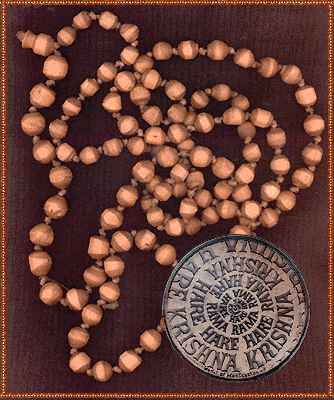
"Although Madhavendra Puri was not interested in eating and sleeping, his interest in chanting the maha-mantra was as acute as if he were an aspiring transcendentalist rather than a paramahamsa. This means that even in the paramahamsa stage, one cannot give up chanting. Haridasa Thakura and the Gosvamis were all engaged in chanting a fixed number of rounds; therefore chanting on beads is very important for everyone, even though one may become a paramahamsa. This chanting can be executed anywhere, either inside or outside the temple."
Caitanya-caritamrta, Madyam lila 4:125
At the conclusion of Tulasi-arati, during the 1-1/2 to 2-hour period before Guru-puja begins, the devotees take time for chanting japa. By definition, 'japa' means personal chanting on beads and hearing the Holy Name. Since time immemorial, the devotees have preferred to chant japa in the early morning hours. Those who are able arise well before Mangala-arati and begin chanting their prescribed rounds, often finishing their rounds after Tulasi-arati.
Srila Prabhupada's program for chanting japa requires the devotees to chant sixteen rounds over the course of the day. With a little practice, you should be able to chant each round in approximately 8 minutes, allowing the full 16 rounds to be done in about two hours and fifteen minutes. If you're chanting at high speed, and a round takes only four minutes, you're probably pushing it. The standard that should regulate your japa speed is how clearly you are being able to articulate the Holy Name. One has to be careful not to fall into bad habits, like dropping, slurring or mumbling words. This is a very easy mistake to make, particularly when you're anxious about time. In the beginning, just try to pronounce the words as clearly as possible at a speed that will enable you to get your rounds done within an appropriate amount of time.
It's fine to break your rounds up over several periods during the day. While it is preferable to chant japa in the early morning, use your common sense to determine what works best for your circumstances. Regardless of the schedule you decide on, regularity and the right atmosphere are most important.
At the bottom of this page is a link to various explanations of the Maha-mantra, and most importantly, Srila Prabhupada's Purport to the Hare Krsna Maha-mantra. As Gaudiya Vaisnavas, our emphasis is on Sri Krsna and Lord Caitanya, so we focus on Krsna-lila and Caitanya-lila when chanting japa, particularly thinking of Lord Balarama (Nityananda) when chanting 'Rama'. Srila Prabhupada stated that others may think of Lord Ramacandra when chanting 'Rama', and that is non-different, but as Gaudiya Vaisnavas, we think of Balarama. Given the amazing pastimes of Krsna and Caitanya lila, we may remain engaged for a lifetime thinking of nothing else.
How loudly you chant is a personal choice. Srila Prabhupada encouraged the devotees to loudly chant the Holy Name during kirtana, but when you're chanting japa together with others in a temple room or elsewhere, you should not interfere with other people's chanting by being too loud with your own rounds.
"Chanting a mantra or hymn softly and slowly is called japa, and chanting the same mantra loudly is called kirtana. For example, uttering the maha-mantra (Hare Krsna, Hare Krsna, Krsna Krsna, Hare Hare. Hare Rama, Hare Rama, Rama Rama, Hare Hare) very softly, only for one's own hearing, is called japa. Chanting the same mantra loudly for being heard by all others is called kirtana. The maha-mantra can be used for japa and kirtana also. When japa is practiced it is for the personal benefit of the chanter, but when kirtana is performed it is for the benefit of all others who may hear. In the Padma Purana there is a statement: "For any person who is chanting the holy name either softly or loudly, the paths to liberation and even heavenly happiness are at once open."
Nectar of Devotion, Chapter 9
For those who find it difficult to sit and chant, walking and chanting is also acceptable. One has to be careful of not falling asleep, so try not to be too comfortable. Particularly in the early morning hours, you may find it hard to keep from nodding off. For that reason, some devotees prefer to go for 'japa walks'. You can go outside and chant as you circumambulate the temple or go for walks in the neighborhood. When 'japa walking', try not to become too distracted with visual experiences. Ideally, you should simply be hearing the Holy Name and thinking of Krsna in some way, shape or form when you're chanting His Holy Name. In many temples, the men circumambulate the front portion of the temple, by the altar, while the women circumambulate the rear half of the temple during the morning japa period.
Japa is a means by which one can try to control the mind. If the mind is wandering, one has to make a concerted effort to bring it back. Srila Bhaktisiddhanta Saraswati was quoted as saying 'when you get up from bed, you beat your mind a hundred times with your shoe, and when you go to bed, you beat your mind a hundred times with a broomstick. Then you will be able to control your mind.' The mind can be particularly undisciplined in the morning, when it wants to plan out the day or think about solving various problems you'll be facing. One should also avoid talking to others during the morning japa period, even though there are likely to be others in the temple room or in the vicinity at home. Fight the temptation to chat, so you won't disturb your japa program, or another's.
By and large, japa is a personal matter. Whether a person is chanting their rounds or not is ultimately very subjective, and should not become a matter for public discussion. For instance, someone might say that they've chanted 16 rounds, but who is to know what the quality of those rounds was, or how many offenses may have been committed while chanting? Although Srila Prabhupada recommended that we chant 16 rounds each day, he also made clear that quality is ultimately more important than quantity. If one finds that they have to chant poor rounds in order to get their 16 rounds done, it's better for them to chant fewer rounds and do them nicely.
"These are different, nine processes. Sravanam kirtanam. Sravanam means hearing, and kirtanam means chanting, chanting. So by this process... Just like I chant and you hear, and you chant and I hear. Parasparam. Bodhayantah parasparam. This is the factual activities of devotion in devotional society. This bodhayantah parasparam: I chant, you hear, and you chant, I hear. So by this process, the transcendental name, the sound incarnation of the Supreme Lord, becomes manifest, manifest so that we can realize God simply by chanting and hearing. Simply by chanting and hearing that will be realized. Of course, there are some rules and regulations for chanting, but in the beginning we haven't got to observe those rules and regulation at the present. First of all let us have the taste for chanting; then we shall be little careful that the rules and regulations are followed."
Srila Prabhupada Lecture, 09-08-66, New York

Practice and Paraphernalia
Make sure your hands are carefully washed before beginning japa. Chant on the 108 beads by gently rolling them between the middle finger and the thumb. Never touch the beads with the index finger, which is generally used for a host of unpurified activities. Instead, keep that finger on the outside of the japa bag, placing it through the small enclosure in your bag which is made for that purpose. If you use your hands for anything other than chanting during the japa period, wash them again before coming back to your beads.
When chanting, begin with a bead next to the large 'head' bead. Chant around the beads, but never cross the 'head' bead. Rather, change direction on the beads, turning back the other way. Avoid having japa beads that are so small you can't be sure if you're chanting on one bead or two beads. Be careful not to skip beads, and don't skip ahead to the next bead while in the middle of the mantra. As you complete each round, pull down one of the small counter beads hanging on the outside of your bag, which are intended to help you keep track of the completed rounds.
Tulasi beads are considered the topmost for japa mala, but other beads may also be used. After Tulasi, Neem beads are generally considered the best. Most any kind of wooden beads will do. Rudraksa beads, however, are not generally used by Gaudiya Vaisnavas, as they are symbolic of a different spiritual practice.
Ideally, one should cultivate and offer worship to Srimate Tulasi-devi. When Her plant form dies a natural death, you may then make beads out of Her branches. While the bead making process is somewhat tedious (drilling, not splitting, polishing, etc.), it is preferable to buying beads commercially. Even when you buy Tulasi beads from the wallahs in Vrindaban, you can't necessarily be certain that Tulasi-devi was properly respected in the process. You might also make arrangements to get branches of a departed Tulasi from a temple (particularly those located in tropical climes, where Tulasi grows abundantly).
When you get a new set of Tulasi or neem beads, soak them in oil for a day or so before you start using them, so they don't crack and break with use. It's best to use Sandlewood oil, or mustard oil. If neither are available, you can use any vegetable oil (but not petroleum-based oils). Avoid using ghee, because it has a tendency to turn rancid with heat.
If stringing your own beads onto a cotton string, be sure to use a heavy gauge cotton, or one reinforced with nylon, so your beads don't break from daily wear and tear. Tie your beads in such a way as they don't get tangled up all the time in your bead bag. If there's too much string between the beads, they can become very tangled, and it's frustrating to have your japa interrupted by having to sort the tangle out.
It's become a bit of a trend for people to buy increasingly large strands of japa beads. Some devotees discourage this practice out of concern that it encourages the harvesting of live Tulasi plants for commercial purposes.
You may also wish to have two sets of japa beads: a small set that you can carry during the day, and a bigger set for home/temple use, which you may find it easier to concentrate on. It's always nice to have beads that are tapered, because the tapering sizes helps keep your mind on the progression of the round. Ideally, your Tulasi beads should be made from a single Tulasi plant, and in that case the bead size will naturally taper, as stalk and branches of various diameters are used in the making.
Japa bags should be made of cotton or silk rather than synthetic fabrics. Your japa beads and bag should be personal, rather than shared with another person. Today, bags come in a variety of sizes, colors and prints, so keeping track of your bag should be easy. It's better to keep beads in their bag rather than hanging them up on the wall or wearing them, as this protects them from dirt and damage. It's best to not use your bead bag to carry other items (keys, money, other paraphernalia) unless your bead bag has a special pouch on the outside for that purpose. Even then, remember that Srimate Tulasi-devi is present, and should receive all respects. Be careful not to let the beads touch anything, especially the floor. Always keep your japa bag clean and in good repair, and make sure that the bag is big enough to accommodate your beads, so they don't keep falling out.
Using 'clickers' instead of japa beads is a somewhat controversial practice, but is often employed by devotees who wish to chant their rounds while commuting long distances in a vehicle, or under other circumstances where beads might be difficult or dangerous to use. Devotees have been known to glue half a tulasi bead onto their clicker so they're touching Tulasi while chanting. As with all things, clickers should be used within the bounds of common sense.
Most importantly, don't starve your beads! Sri Tulasi-japa desires to be picked up and used liberally every day for the glorification of Lord Hari!
Taken from http://www.harekrsna.com/practice/sadhana/morning/japa/japa.htm
Vishnujana Swami
on chanting

on chanting
Haribol, I knew you'd like this-
Devotee: Can you give some practical advice as far as chanting kirtan and japa?
Vishnujana Swami: Kirtan is to be executed constantly. Lord Chaitanya went through the streets and He invited everyone to join in the sankirtan movement, constantly chanting the holy names of the Lord. So arrangements should be made for the chanting of the holy names of the Lord to go on in every town and village, constantly. In every media -- radio, television, etc. -- chanting should be going on, along with nice dancing and feasting. That's the program.
Then, as far as japa is concerned, one has to chant personally for his advancement in Krishna Consciousness, 16 rounds daily on his beads. There are helps in chanting attentively. One of these helps obviously is simply the beads. The beads are given to you by the Spiritual Master, and you chant Hare Krishna, paying attention to each bead. And this vow of chanting attentively, on each bead, this vow impresses the Supreme Lord. He sees that you are serious, and He gives you realization. It's that simple. You chant in regulation and vow; the Supreme Lord sees, "Oh, he is serious. He's keeping his vow," and then He gives you realization. If you don't chant attentively, if you don't, you're thinking of making the 10 kinds of offenses while chanting, then the Lord will see that you're desiring something else. After all, you can't fool Him -- He's livin g right there within your heart. He knows your desire before you even speak or think. So, if while you're chanting you're committing offenses, thinking of sense gratification, being attached to material objects, then the Lord will know what you really want, and therefore you won't feel the bliss of chanting offenselessly. The Lord won't allow you to feel that, because you are desiring other things. See, the main thing is to realize that "I'm dealing with Krishna." That's the main thing.
That this chanting -- "I'm being with Krishna; therefore I have to be very careful." Krishna can't be fooled like you can fool me. You can easily fool me, that you are chanting attentively, you see. That's easy to fool me because my senses are imperfect... [break] ...Actually, if you see me come in the room and you are thinking something nonsense and doing something nonsense, and immediately you feel ashamed, actually you should feel that way twenty-four hours a day, because Krishna is always there, witnessing. You know how it is that you'll be doing some nonsense and you're thinking that no one is watching. "No one knows what I am thinking." But as soon as your godbrother comes in and suspects you, then immediately you feel ashamed, "Oh, I'm doing something which is not good." Now, the difficulty here is that you don't realize that it's not good for you. It's not that you're offending me; you're hurting yourself -- this is what they don't understand, you see. This means that he doesn't understand that he's hurting himself. So herein lies a great difficulty: there's a blind spot in our consciousness, that we don't know that our actions are directly harming our development in Krishna Consciousness, if we're not humble in dealing with Krishna at every moment. We don't understand that. We don't give that value, you see, we think we're simply socially existing. That if I do some offense, then my godbrother will criticize me and I have to bear his criticism.
No. You're hurting yourself for not realizing that you're dealing with Krishna. That is the worse suffering. That's the worst illusion, you see. Therefore japa is meant as an individual practice of Krishna Consciousness. So that for some time, at least two hours during the day, you stop socially dealing. You understand? You stop socially dealing and you realize that "I am dealing with Krishna." If I make offense in thought, well here's the holy name right on my lips; the Lord is right there, and He is witnessing. You can easily fool me as we're going through the day's activities, if you're looking lustfully on a girl or this or that. That's easy, you see, and if I catch you, you can feel that "Oh, Vishnujana has caught me," or this or that. But the difficulty is that you don't realize that you're dealing with Krishna. Therefore one of the beautiful aspects of japa is it forces you to realize that "When no one else is around, and I'm chanting Hare Krishna, I'm dealing with Krishna." And, "Unless I do it properly, then I'm being offensive to the Lord." There's no one else to hurt but me. I can't hurt Vishnujana, I can't hurt this one, I can't hurt that one, you see. I can't offend them, all I can do is offend God and myself. Therefore, this solitary chanting of japa is also recommended. Japa is done individually. Sometimes I see devotees, they have a collective japa class. No, japa means individually, we are chanting, for two hours. So try to utilize that time, scrutinizingly...
Bhagavad-gita Class 4.36 - St. Louis, Missouri -- March 27, 1973
Read original at http://www.krishnaconsciousnessmovement.com/vjs.html
Saturday, May 27, 2006
Defendamos nuestra Fé Católica
Habia estado buscando información acerca de nuestra Fé Católica, cuando llege a este sitio. www.corazones.org
En el encontre diversos enlazes entre los cuales el que mas me llamo la atención fue el de Apologética
En ese sitio visite algunos otros que allí encontre muy interesantes, entre ellos y en orden aleatorio (segun lo vi y pegue el enlaze a este post) recomiendo los siguientes que e visitado y me ha sido de provecho
Repeticíon en la oración Muy bueno leerlo para cuando te pregunten acerca de tu devoción al Santo Rosario
Misticismo Es momento de darnos cuenta que en el cristianismo si hay buenos misticos y que no hay que ir al oriente para encontrarlos
Evangelio de Judas
Sábado o domingo - ¿Cuál es el día del Señor?
Enlaces de Apologética Aún no los he revisado todos despues le estare comentando
Libérese de la Pornografía: 12 pasos
En mis proximos post les traere algo acerca de la tradición del Escapulario y acerca de la vida de los Santos, estare llevando informacíon acerca de San Benito, como de costumbre citare la fuente y el enlace de donde tome la información
En el encontre diversos enlazes entre los cuales el que mas me llamo la atención fue el de Apologética
En ese sitio visite algunos otros que allí encontre muy interesantes, entre ellos y en orden aleatorio (segun lo vi y pegue el enlaze a este post) recomiendo los siguientes que e visitado y me ha sido de provecho
Repeticíon en la oración Muy bueno leerlo para cuando te pregunten acerca de tu devoción al Santo Rosario
Misticismo Es momento de darnos cuenta que en el cristianismo si hay buenos misticos y que no hay que ir al oriente para encontrarlos
Evangelio de Judas
Sábado o domingo - ¿Cuál es el día del Señor?
Enlaces de Apologética Aún no los he revisado todos despues le estare comentando
Libérese de la Pornografía: 12 pasos
En mis proximos post les traere algo acerca de la tradición del Escapulario y acerca de la vida de los Santos, estare llevando informacíon acerca de San Benito, como de costumbre citare la fuente y el enlace de donde tome la información
Saturday, April 22, 2006
JEZU, UFAM TOBIE!

Roguemos para que Dios se digne mostrar Misericordia a Toda la Humanidad
Oh Misericordiosísimo Jesús, de quien es muy propio del ser Misericordioso con Nosotros, y perdonarnos, no mires nuestros pecados, sino mira solamente la enperanza que tenemos en tu infinita bondad. Recíbenos a todos en tu Misericordisísimo Corazón y no rechases a ninguno. Te lo suplicamos por el amor que te une con el Padre y el Espíritu Santo. "Muestranos Tu Misericordia, oh Señor como nosotros confiamos en Tu Santo Nombre, porque Tú eres Todopoderoso, amabilísimo, paciente, Fiel Bueno y Misericordioso".
Eterno Padre, mira a toda la humanidad con Ojos Misericordiosos, y especialmente a todos los pobres pecadores, cuya sola esperanza es el Misericodiosísimo Corazón de tu Santísimo Hijo y Nuestro Señor y Salvador Jesucristo. Por su dolorosa Pasión, muéstranos Tu Misericordia, para que todos nosotros glorifiquemos Tu Omnipotencia por toda la eternidad. Amen
Tomado de la "Novena de la Misericordia" Primer Día, Viernes Santo
Subscribe to:
Posts (Atom)